Why Is My Vinyl Siding Popping, Cracking, or Making Noise?

The Short Answer
Vinyl siding often makes popping, cracking, or creaking sounds because the material naturally expands and contracts as temperatures change. In Northern Virginia, where seasonal and day to night temperature swings are common, that movement can be more noticeable, especially in the morning and evening.
Noise that is occasional and occurs during temperature changes is generally not a structural concern. Noise that is persistent, localized to one area, or accompanied by visible gaps, warping, or water intrusion warrants a professional evaluation.
Vinyl siding is one of the most widely installed exterior products in Fairfax County, Loudoun County, and Prince William County homes — valued for its durability, low maintenance, and weather resistance. But homeowners frequently notice sounds they didn't expect: pops when the sun hits the wall in the morning, creaks during cold snaps, or a subtle rattle when the wind picks up. This page explains what causes those sounds, when they indicate a problem, and what your options are.
Why Does Vinyl Siding Make Noise as Temperatures Change?
Vinyl siding expands and contracts with temperature — this is normal behavior for the material, not a defect. Vinyl siding naturally expands in warmer temperatures and contracts in colder weather, which is part of how the material responds to changing conditions. On a Northern Virginia home, a 12-foot vinyl siding panel can move several fractions of an inch across seasonal temperature swings..
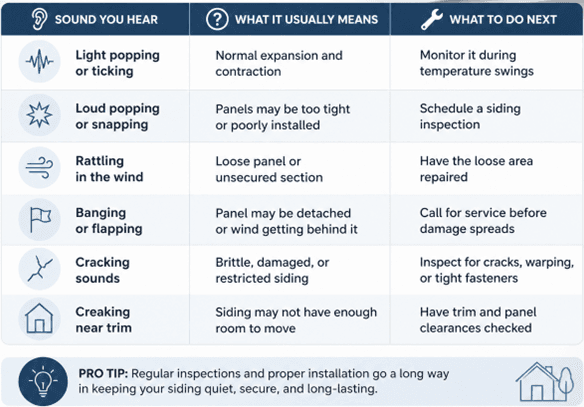
The noise happens at transition points: panel overlaps, J-channel connections, corner posts, and areas where siding meets trim or window frames. When panels shift against fixed fastening points or adjacent materials, the friction produces the popping or creaking sounds homeowners notice.
Sounds that occur primarily in the morning as the sun warms the wall, or in the late afternoon as temperatures drop, are almost always thermal in origin. These sounds are expected and do not indicate a problem with the siding itself.
Can Improper Installation Cause Vinyl Siding to Make Noise?
Yes — and it is one of the more common causes of persistent or abnormal noise. Vinyl siding is designed to float, meaning fasteners should be driven through the center of the nail hem slot, not tight against the panel. This allows each panel to move laterally as temperatures change.
When panels are nailed too tightly — a frequent installation error — they cannot expand freely. Instead of floating, the siding binds and then releases suddenly, producing sharp popping sounds louder than normal thermal movement. Over time, over-fastened panels are also more likely to buckle, warp, or crack.
Other installation factors that contribute to abnormal noise include:
Panels cut too long at corners or trim intersections, leaving no room for expansion
Inadequate overlap between horizontal panels, allowing them to separate or rattle in wind
Panels installed over an uneven substrate, creating pressure points that amplify movement sounds
If the noise is more pronounced in one section of the wall than others, or if it developed shortly after installation or a repair, improper fastening is worth investigating.
What Does It Mean When Vinyl Siding Rattles or Sounds Loose?
A rattling sound — distinct from the sharp pop of thermal movement — usually indicates that one or more panels have come loose from the wall. This can happen when fasteners pull through an aging nail hem, when wind uplift has displaced a panel, or when original installation left insufficient overlap.
Loose panels are worth addressing promptly. Beyond the noise, a displaced panel creates a gap in the water management system of the wall assembly. Northern Virginia's freeze-thaw cycles — with temperatures routinely dropping below freezing between November and March — can force water into wall cavities through even small gaps, leading to moisture damage behind the siding.
A loose panel is typically visible on close inspection: look for sections where the lower edge of a panel has lifted away from the course below it, or where the panel surface appears to bow or flex when pressed.
When Do Siding Noises Signal a Bigger Problem?
Most vinyl siding noise is harmless. The following conditions indicate that a professional evaluation is warranted:
Noise accompanied by visible warping, buckling, or cracking in the panels
Noise concentrated in one wall section rather than distributed across the structure
Panels that shift or flex noticeably when touched
Evidence of water intrusion near the noisy section — staining, efflorescence on the foundation, or interior moisture
Siding that is more than 20–25 years old and showing color fading, brittleness, or surface crazing alongside the noise
Aging vinyl becomes less flexible over time. Panels that have lost plasticity are more likely to crack rather than flex during thermal movement, and the sounds they produce tend to be sharper and more irregular than the sounds of healthy siding expanding normally.
Is Fiber Cement Siding Quieter Than Vinyl?
Generally, yes. Fiber cement siding—such as products from James Hardie—has a significantly lower rate of thermal expansion than vinyl. That means fiber cement panels move less as temperatures rise and fall, which reduces the popping, creaking, and movement-related noise that is common with vinyl siding.
James Hardie Industries manufactures regional siding formulations through its HardieZone® system, designed for climate-specific performance. In Northern Virginia, products like HardiePlank® lap siding and HardiePanel® vertical siding are built to handle seasonal moisture, temperature swings, and long-term weather exposure, and are available with ColorPlus® Technology finishes that are factory-applied for added consistency and durability.
Fiber cement is not entirely silent — it is still a rigid material installed over a wood or engineered wood substrate that can shift seasonally. But the magnitude of movement, and the resulting noise, is substantially lower than with vinyl.
Whether noisy vinyl warrants replacement depends on the condition of the panels and the overall system. Siding that is structurally sound, properly fastened, and performing well from a moisture management standpoint does not need to be replaced because it makes thermal sounds. When aging or compromised siding does need to come off, homeowners can choose between CertainTeed vinyl — which Pond also installs — or fiber cement. Both are available through the same in-home estimate process.
What Should I Do If My Vinyl Siding Sounds Unusual?
Start by observing when the noise occurs. Thermal sounds during temperature transitions are normal. Persistent noise, localized noise, rattling in wind, or any sound accompanied by visible changes to the siding profile indicates a condition worth evaluating.
Pond Roofing has completed thousands of siding evaluations across Fairfax County, Loudoun County, and Prince William County. Every evaluation begins with a full system assessment: not just the siding panels, but the substrate, flashing, trim integration, and moisture management performance of the entire wall assembly.
Frequently Asked Questions
Yes. Popping sounds during temperature changes are normal behavior for vinyl siding. PVC expands and contracts with heat and cold, and the friction at panel connections produces noise. In Northern Virginia's climate, where temperatures can swing significantly within a single day, this effect is common and expected.
Morning and late afternoon are periods of rapid temperature change — the sun heats the wall surface quickly in the morning, and temperatures drop as the sun angle changes in the afternoon. These are the times when vinyl panels move most actively, which is why the sounds tend to be louder during those periods.
Yes. A displaced vinyl siding panel creates a gap in the wall's water management system. In Northern Virginia's climate, rainwater and melting snow can enter the wall cavity through loose siding, particularly at seams, corner posts, and areas around windows and doors. Moisture behind siding can cause damage to the sheathing and framing over time.
Fiber cement siding, such as James Hardie HardiePlank, has a significantly lower thermal expansion rate than vinyl. This means fiber cement panels move less in response to temperature changes and produce substantially less noise. Fiber cement is also more dimensionally stable over its service life than vinyl, which tends to become more brittle with age.
Yes. Pond Roofing installs CertainTeed vinyl siding across Northern Virginia, including insulated and non-insulated profiles in a range of styles and colors. Pond also installs James Hardie fiber cement siding for homeowners who want a different performance profile. If you are evaluating both materials, the in-home estimate covers both options — there is no pressure toward one or the other.
Pond Roofing holds CertainTeed SidingMaster™ PRO credentialing and is a James Hardie Industries Preferred Remodeler — manufacturer-recognized designations that reflect advanced installation training and adherence to product-specific installation standards. That matters because proper installation directly affects long-term performance, weather resistance, and warranty eligibility.
Up to $500 OFF*
Roofing, Siding, Gutters, Windows, Doors, Skylights, Sun Tunnels
Recent Posts
For many homeowners, the thought of replacing their old windows is enough to make them cringe...
If your windows have ceased to do what they are supposed to do (keep you warm and protect your home from rain, wind and storms), take a walk around your house and decide whether your windows need to go...
As the spring season approaches, it’s safe to say that you’ll want to take full advantage of the warmer weather...
Have you been putting off your replacement window project...
Our Process Makes Exterior Remodeling Easy
%20(1)-250x237.webp&w=640&q=75&dpl=dpl_7FDJxkFEERsfySvAZHWk1vKfcK3z)
At Pond Roofing, we’ve perfected The Pond Proven Process, the result of more than 60 years’ worth of fine tuning. This process is the magic sauce that will help you have a peaceful experience.
Our Values Are at the Heart of Our Business
Compassion
Caring Enough to Take ACTION to Make it Better
Open Communication
Listen and Clarify, Speak UP, Respond Quickly
Relentless Improvement
Always Improving our Skills and Execution
Excellence
Always Do Your Best
Explore Our Amazing Siding Gallery
Customer Reviews
Excellent service. Any question I had was addressed in a friendly yet professional manner. I have used Pond before for replacement windows and siding and most recently for new roofing. I highly recommend them for their responsiveness and the high quality of their work.
Easy communication with tons of photos and excellent job! Pond Roofing even came back to replace the color of the shingles to our satisfaction. The property was in McLean and they made me look great since my landlord client was very impressed. The swag cookies to our tenants was an added bonus. :-) Thanks so much!
Very fast initial response time and great customer service. Repair work was done (by prearrangement) while we had to be out of town and it looks great now that we are back. We have used Pond before and would call them first if we need roofing work in the future. Thanks!
Great communication, very professional repair crew. We have a new construction house that had some issues with vent seals after 10yrs and Pond fixed 8 different areas in one day--very happy with the work.
I recently hired Pond Roofing to check out a leak. They did a great job coming in on time and to troubleshoot the issue. Their pricing was competitive and overall service was excellent. I’m very happy with their work.
Pond Roofing was very responsive and knowledgeable about the condition of our roof. They delivered before the expected date and their work was impeccable. I cannot recommend working with Shanti enough.
Quality and Integrity. Terrific job on a roof repair. Called for a minor fix which was expertly accomplished. Patrick performed a complete inspection, ensuring no other damage or work needed. Perfect!





Trusted by some of the biggest names in siding!

Our Location
Mon-Fri: 8am – 4pm
Sat-Sun: Closed